
Anthropic AI Security Framework is a Start but Fails to Deliver

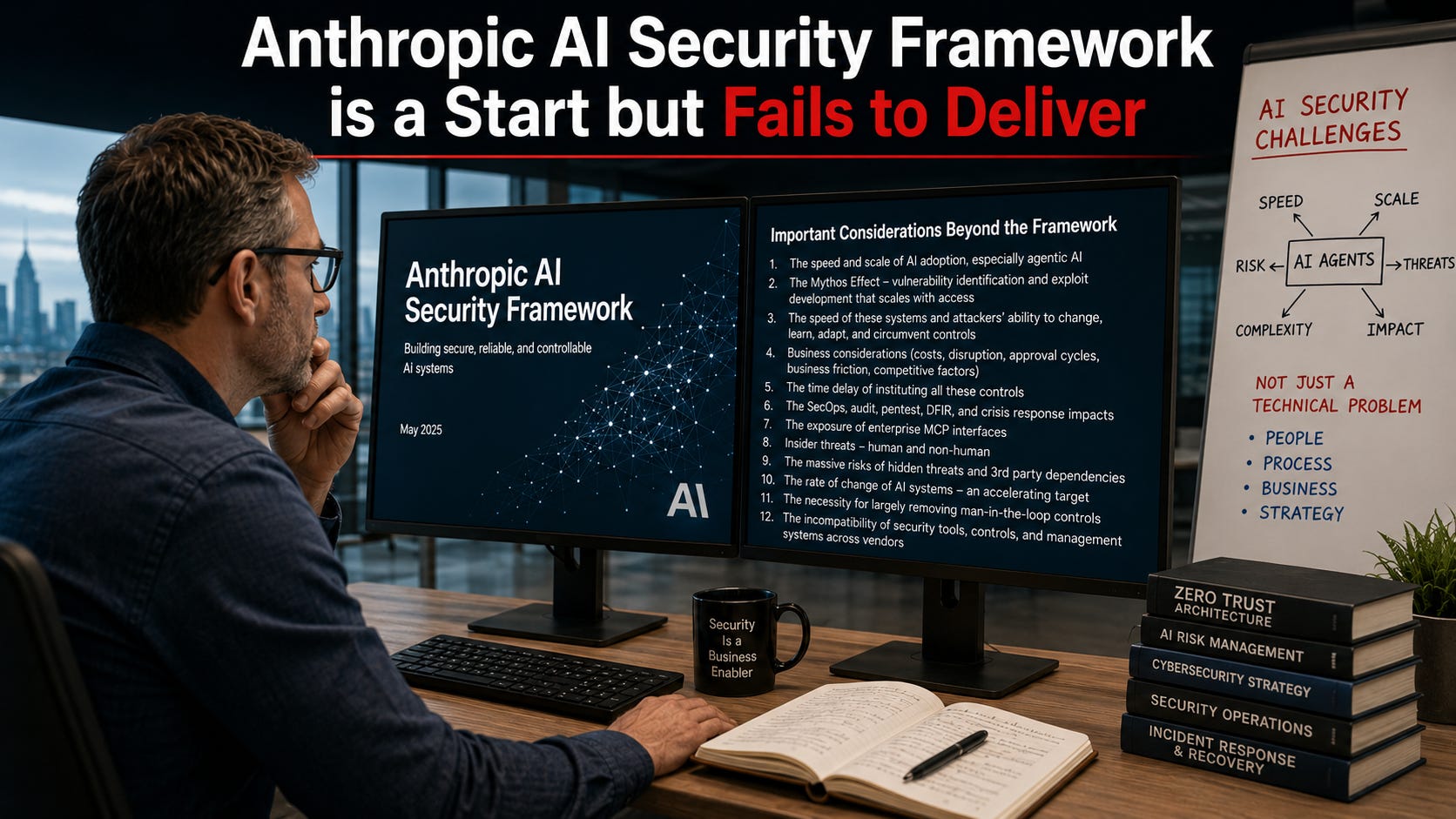
Anthropic publishes a security framework for autonomous AI agents but fails to deliver a realistic plan.
I really like what Anthropic is doing in the industry and how its ethics is driving cybersecurity conversations. This paper is a good start, albeit a basic one that was created by technologists, but it is not realistic as a practical framework for comprehensive AI security. It is a good conversation starter and important step to move forward with strategic exploration of cybersecurity risk management.

The framework, based upon Zero Trust principles, It is not advocating anything new per se, just applying technical methodologies that were designed for slower, less complex, and more predictable systems.
It reminds me of what the industry has attempted to implement for insider-based risk (trusted workers and credentials).
That said, it is deficient is many ways. Anthropic needs to bring in cybersecurity experts that can see the strategic issues beyond just the technology and include business, people, and process aspects.
It needs to be expanded and architecturally changed to address the following considerations (not a complete list):
The speed and scale of AI adoption, especially agentic AI, that changes the problem as access, dependencies, and capabilities increase at a near exponential level
The Mythos Effect - vulnerability identification and exploit development that scales with access, including in the very tools and processes being recommended
The speed of these systems and attackers’ ability to change, update, learn, adapt, and circumvent controls
Business considerations (costs, unwillingness for business disruption, approval cycle limitations for changes/updates, business friction, and competitive factors)
The time delay of instituting all these controls, which will likely be outdated by the time they are in place
The SecOps, audit, pentest, DFIR, and crisis response/recovery impacts of all these complex controls
The exposure of enterprise MCP interfaces that intentionally expose sensitive systems and data to external parties
Insider threats – human and non-human types that will use these tools and controls for their malicious objectives
The massive risks of hidden threats and dependencies of 3rd party risks
The rate of change of AI systems – an accelerating target to try and wrap controls around which causes chaos for security vendors to keep pace and introduces new risks
The necessity for largely removing man-in-the-loop controls, to keep this security framework effective
The incompatibility of security tools, controls, and management systems across the multitude of vendors that will require cooperation and coordination
I fully appreciate how Anthropic is leading the discussions and proactively working to elevate AI cybersecurity.
Much more work is needed before we approach any capabilities that are effective, efficient, and support business objectives/limitations.
The journey continues.
BLUF: The paper proposes an implementation guidance and control taxonomy; but I wouldn’t describe it as an assurance framework. TRL-6/7 as implementation guidance/control taxonomy, TRL-8 only after independent control mapping and red-team validation.
The proposed approach should be mapped against NIST SP 800-207, CISA ZTMM, NIST AI RMF, OWASP Agentic AI guidance, MITRE ATLAS/ATT&CK, and FedRAMP High before being used in government-facing materials. And legal/compliance claims should be independently validated.